

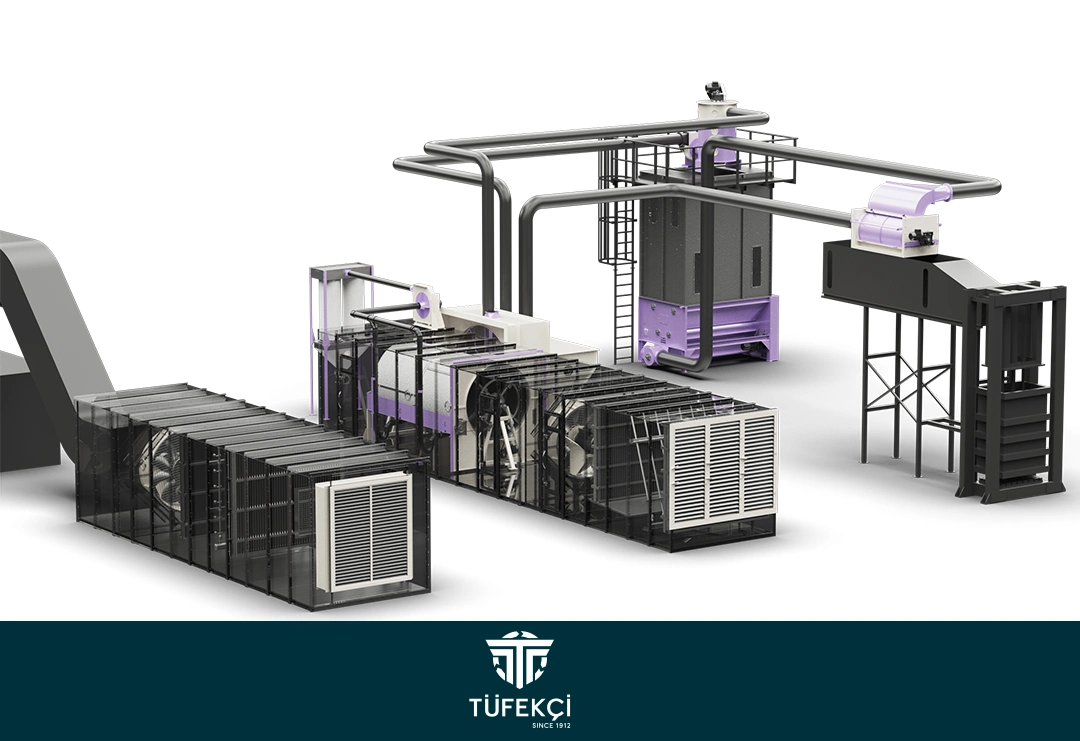
Air conditioning in a textile plant is not about comfort. It is about keeping fiber moisture, air temperature and airborne particle levels inside a narrow band so that spinning, weaving and knitting machines run without interruption. Our air conditioning products are built around that single requirement, and the category is led by the Packaged Air Handling Unit, a compact system that carries every core climate function inside one body.
The idea behind a packaged unit is simple. Instead of building an air conditioning room section by section on site, the filtration stage, the humidification stage, the heating and cooling stage, the fan group and the control equipment are assembled in the factory and delivered as a finished machine. The plant receives a unit that has already been tested, balanced and wired, which shortens the time between delivery and first production run.
These units belong to our Package-Type Power Plant Products family and are frequently installed alongside packaged filtration equipment so that conditioned air supply and dust return work as one loop. Below you will find what the category covers, where it performs best, and what to check before requesting a capacity study for your own facility.
What a Packaged Air Conditioning Unit Handles Inside the Plant
A packaged unit takes return air from the production hall, cleans it, adjusts its temperature and humidity, then pushes it back into the space through the duct network. That cycle repeats continuously during production, which is why the internal components are sized for permanent operation rather than seasonal use.
Temperature control comes first because fiber behaviour changes with heat. Yarn breakage rates, static build-up and machine surface temperatures all shift when the hall drifts a few degrees. The unit corrects that drift before operators notice it on the floor.
Humidity control follows, and in textile work it carries even more weight. Cotton, viscose and blended fibers absorb and release moisture depending on the surrounding air, so relative humidity directly affects yarn strength and elongation. A stable humidity level keeps those properties consistent from the first bobbin of a shift to the last.
Air cleanliness completes the cycle. Return air arrives loaded with fly and short fiber, and the unit removes that load before it reaches the coils and the fan. Clean air leaving the unit also means less deposit on machine surfaces and fewer stoppages for cleaning.
Components Working Together Inside a Single Body
Every packaged unit is built from proven sections that we also produce individually under Our Climate Control Products. Combining them in one cabinet removes duct losses between stages and simplifies the mechanical room layout.
The main sections included in a standard configuration are:
- Filtration section: captures fly and fiber from return air, protecting the coils and the fan wheel. In heavier applications this stage works together with a Rotary Filter installed upstream.
- Heating and Cooling Coil: brings the air to the target temperature using the plant's water or refrigerant circuit.
- Humidification Units: add controlled moisture to reach the relative humidity value the process requires.
- Fan group: moves the conditioned air at the designed static pressure, commonly supported by an Axial Fan on the exhaust side.
- Aluminum Air Damper set: regulates fresh air, return air and exhaust air ratios according to outdoor conditions.
- Control and automation equipment: reads sensor values and adjusts every stage without operator input.
Because these sections share a common frame and a common control logic, the unit reacts to a change in one parameter without disturbing the others. That balance is difficult to reach when equipment from different sources is combined on site.
Production Areas Where Packaged Units Perform Best
Ring spinning and open-end spinning halls are the most demanding environments in the category. Fiber is exposed, machine speeds are high and even short humidity swings show up as breakage. A packaged unit placed close to the hall keeps supply conditions steady across the full floor area.
Weaving preparation and weaving halls come next. Warp yarn passes through repeated tension cycles, and dry air makes that yarn brittle. Facilities running high loom counts usually pair air conditioning with our Textile Air Conditioning Solutions planning service to match supply points with machine layout.
Knitting halls, fiber preparation areas and blending rooms also benefit, though their target values differ. Knitting generally tolerates a wider humidity band but reacts strongly to temperature rise caused by machine heat, so cooling capacity carries more weight in these projects.
Beyond textile production, the same equipment serves industrial areas that need controlled conditions in a defined volume: quality laboratories, packaging halls and storage areas where raw material moisture must stay fixed. For laboratory scale requirements, the Laboratory Air Conditioner is usually the better match.
Why Facilities Prefer Packaged Systems Over Site-Built Rooms
Construction type air conditioning plants remain the right answer for very large halls, and we produce them under Our Construction-Type Power Plant Products. The packaged approach wins in different situations, and the difference usually comes down to time, space and predictability.
Time is the first factor. A concrete air conditioning room takes weeks of civil work before mechanical installation even begins. A packaged unit arrives finished, is positioned, connected to ducts and utilities, then commissioned. Facilities adding a new production line to an existing building rarely have the schedule for the alternative.
Space is the second. Packaged units occupy a defined footprint that can be planned on a drawing with certainty. There is no need to dedicate a building section to air conditioning, which frees floor area for machinery.
Predictability is the third and often the most valuable. Everything inside the cabinet was assembled and tested in the same factory, under the same quality control, so performance at site matches the performance figures in the project file. Field assembly always introduces variation, and variation in air conditioning turns into variation in yarn quality.
Airflow Balance and Its Link to Dust Collection
Supply air and return air must balance, otherwise the hall builds positive or negative pressure and doors, windows and openings start pulling uncontrolled air from outside. That uncontrolled air carries dust, heat and humidity that the unit never accounted for.
This is why our air conditioning products are designed to work in the same loop as our Dust and Lint Collection Solutions. Return air passing through filtration equipment reaches the conditioning unit already cleaned, which reduces coil fouling and keeps pressure drop stable across the maintenance interval.
In packaged projects, the return side is typically handled by a Packaged Pre-Filter Unit or a Packaged Rotary Filter Unit, depending on fiber load. Where waste volume is high, a Packaged Mechanical Filter Unit completes the chain by separating collected material for disposal or reuse.
Planning both sides together at the project stage prevents the most common complaint we hear from plants running mixed equipment: air conditioning that performs well on paper but never reaches its set values on the floor.
Automation That Keeps Set Values Steady Without Operators
Manual adjustment cannot keep pace with a production hall where outdoor temperature, machine load and shift patterns all change during the day. Automation handles that continuously, and the control layer is developed under our Electrical and Automation Solutions.
Measurement comes first. Sensor Groups placed in the hall and inside the unit report temperature, humidity and pressure values in real time. The control logic compares those readings against set points and adjusts fan speed, damper position, coil valve opening and humidification output accordingly.
Automation Panels carry that logic and protect the motors through soft starting and speed control, which lowers both energy draw and mechanical stress. For facilities running several halls, SCADA Systems bring every unit onto one screen with trend records and alarm history.
Those records matter more than they first appear. When a quality problem shows up in a production batch, the humidity trend from that shift usually explains whether the air conditioning system was involved or not.
Maintenance Practices That Protect Long Term Performance
Filter condition drives everything else. As fiber accumulates, pressure drop rises, airflow falls and the fan works harder for less air. Checking differential pressure on a fixed schedule is the single most useful habit a maintenance team can build.
Coil surfaces need attention next. A thin fiber layer on the fins reduces heat transfer noticeably, and the loss appears as a system that cannot reach set temperature on hot days even though nothing has failed. Cleaning the coil restores capacity that seemed permanently lost.
Humidification equipment requires water quality control. Mineral content in the supply water determines how often nozzles and surfaces need cleaning, so plants in hard water regions plan shorter intervals.
Fan bearings, damper linkages and belt tension complete the routine list. Original components ordered through our Spare Parts Request form keep the unit within its design values, and our team supports periodic inspections through the Service Request page when in-house capacity is limited.
Planning a Project and Requesting a Capacity Study
Selecting a packaged unit starts with numbers from your own facility: hall volume, machine count and heat load, target temperature and humidity values, outdoor design conditions and the fiber type being processed. These figures determine airflow, coil capacity and humidification output far more reliably than a comparison of catalogue models.
Duct routing and available space come next. The position of the unit relative to the hall affects static pressure and therefore fan selection, so early coordination between mechanical and production planning avoids expensive revisions later.
Finally, consider what the system must connect to. Return filtration, waste handling and, in some projects, a Condenser or equipment from our Complementary Solutions range all share the same air balance. Reviewing them together produces a cleaner installation and lower operating cost.
In short, our air conditioning products deliver factory-built climate control that reaches stable conditions quickly and holds them through continuous production. Share your facility details through the Quotation Request Form or reach our engineering team directly from the Contact Us page, and we will prepare a capacity study matched to your production line.
