

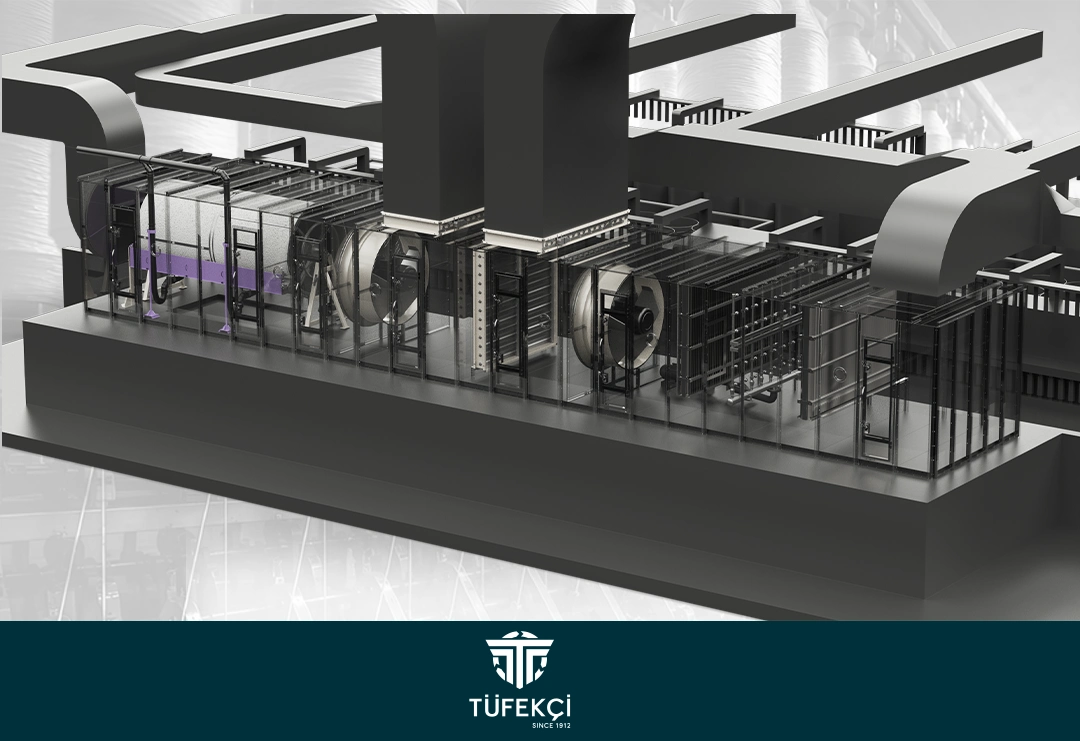
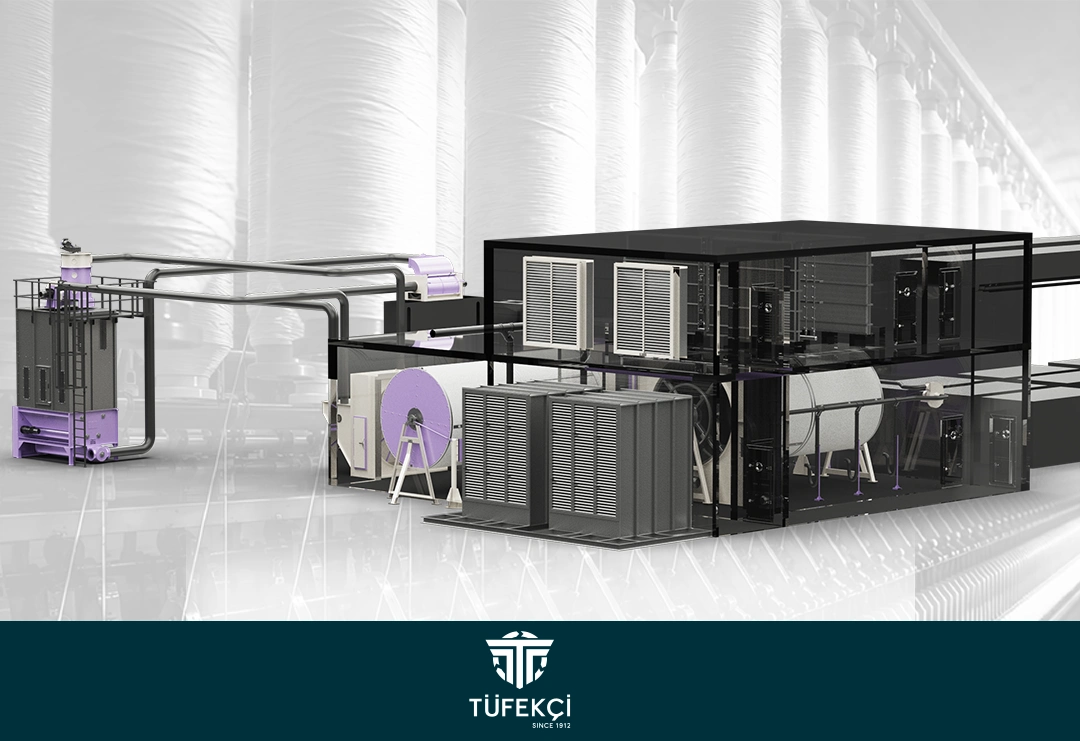
A construction-type power plant is the air conditioning and waste collection centre that is built directly inside your facility, floor by floor and duct by duct, according to the layout of your mill. Instead of arriving as a finished box, every section is engineered for the volume of the hall, the machine park inside it and the yarn count being produced. That is exactly what this product group covers: the individual units that make up a field-erected central plant for spinning, weaving, knitting and nonwoven facilities.
Tüfekçi Makine divides this group into two connected families. The first is climate control equipment, which handles temperature, humidity and air distribution. The second is dust and fiber waste collection equipment, which removes the fly, dust and short fiber that production constantly releases. Both families share the same air circuit, so they are designed together rather than ordered separately.
If you are comparing suppliers, the questions that matter are simple. Which units are included, how are they sized, how do they behave when the machine park changes, and who supports them after start-up. The sections below answer each of these for the construction-type product range.
What Makes a Plant "Construction-Type"
The name refers to the way the plant is produced. Panels, chambers, filters and fans are manufactured in the factory and then assembled on site into a permanent structure, usually in a dedicated basement or plant room under the production hall. Concrete channels, plenum walls and duct runs become part of the building itself.
This method suits facilities with large, continuous air volumes. When a hall is running tens of thousands of cubic metres per hour and cannot afford an interruption, a fixed plant with generous cross-sections gives lower air velocity, less pressure drop and quieter operation. There is also more freedom in shaping the plant around columns, existing walls and awkward ceiling heights.
The trade-off is planning time. A construction-type plant is decided at the project stage, together with the civil works, because the concrete layout has to match the airflow design. Facilities that need faster installation or plan to relocate often prefer package-type plant products instead, where the same functions are delivered in ready-made modules.
Climate Control Products in the Group
Air quality in a textile hall is not a comfort issue. Fiber behaves differently at 45 percent relative humidity than it does at 60 percent, and yarn breakage, machine efficiency and end-product weight all follow that curve. The climate side of the plant exists to hold those values steady through every shift and every season.
Each unit in this family performs one stage of the process, and the units are sized as a chain rather than individually:
- Rotary Filter: continuously cleans return air with a rotating drum and an automatic suction arm, so filtration stays stable without stopping the plant.
- Axial Fan: moves high air volumes at low and medium pressure, which is the typical requirement for supply and return circuits.
- Aluminum Air Damper: controls fresh air, return air and recirculation ratios with adjustable blades and low leakage.
- Heating and Cooling Coil: brings the air to the target temperature using hot or chilled water, sized by row count and fin spacing for the local climate.
- Humidification Units: add moisture through spray and washer sections, holding the humidity band that the process demands.
Together these units form the backbone of Tüfekçi Makine's textile air conditioning solutions, and they are selected according to the heat and moisture load calculated for your specific machine park.
Dust and Fiber Waste Collection Products in the Group
Every spinning and weaving process throws off fiber. Left alone, it settles on machines, blocks coil surfaces, raises fire risk and lowers the quality of the air people breathe all day. The collection side of the plant captures that material at source, transports it and turns it into a form that can be stored or sold.
The range covers the full path from suction point to baled waste:
- Pre-Filter: takes the first and coarsest load off the air stream, protecting the units behind it.
- Rotary Filter: provides continuous self-cleaning filtration for heavily loaded waste air.
- Radial Fan and Dust Fan: generate the higher pressure needed to pull dust-laden air through long duct runs.
- Fiber Conveying Fan: carries collected fiber between units without damaging or compacting it in the line.
- Cyclone and Dust Collector: separate solid material from the air by centrifugal and filtering action.
- Compactor and Briquetting Machine: press loose waste into bales or briquettes, cutting storage volume and transport cost.
- Silo: stores collected material in a controlled way until it is removed.
This chain is the physical form of the dust and lint collection solutions offered for the whole mill.
How the Two Sides Work as a Single Air Loop
In practice there is no wall between climate control and waste collection. Air leaves the plant room, passes through the production hall, picks up heat, moisture and fiber, then returns to be cleaned and conditioned again. A weakness at any point in that loop shows up somewhere else.
If the filtration stage lets fiber through, coils foul and heat transfer drops within weeks. If the collection fans are undersized, dust settles in the ducts and the whole circuit loses pressure. This is why the two product families are calculated on one airflow balance sheet, not on two separate ones.
The same logic applies to return air ratio. The more return air you can safely reuse, the less energy you spend heating, cooling and humidifying fresh air. Good filtration is therefore not just a cleanliness measure, it is the thing that makes energy recovery possible in the first place.
Design Details That Decide Long-Term Running Cost
Two plants with identical capacity on paper can differ by a large margin in annual electricity consumption. Duct cross-section is one reason. Oversized channels cost slightly more in sheet metal and civil work, then repay it every hour through lower air velocity and reduced fan power.
Filter surface area is the second. A generously dimensioned filtration stage runs at lower pressure drop for longer between cleaning cycles, which protects motor life as well as energy bills. Undersized filters look economical at purchase and rarely stay that way.
The third is motor and fan selection. Efficiency class, impeller type and the operating point on the fan curve all matter, especially in plants that run close to continuously. Choosing a fan that sits at its best efficiency point under real conditions, not just at nominal design values, is one of the clearest ways to lower cost over a plant's life.
Access is the quiet fourth factor. Service doors, walkways and clearance around units decide whether routine maintenance takes an hour or a shift, and that difference accumulates over the years.
Control and Automation Across the Plant
A construction-type plant contains many motors, dampers and valves that must react together. Manual operation cannot keep humidity inside a narrow band while outdoor conditions shift through the day, which is why control hardware is treated as part of the plant rather than an accessory.
Central motor control panels manage starting, protection and speed regulation for the fan groups. Automation panels hold the control logic that links temperature and humidity readings to damper positions, valve openings and fan speeds.
Above that layer, SCADA systems give operators a live picture of the whole plant and a record they can review later. When a humidity deviation appears in a specific hall at a specific hour, trend data usually explains it faster than any site inspection. All of this sits within the wider electrical and automation solutions portfolio.
Installation, Commissioning and Ongoing Support
Field-erected plants are built while the rest of the project moves forward, so sequencing matters. Concrete channels, duct routes and equipment openings are agreed with the civil contractor before assembly starts, which prevents the kind of late changes that cost weeks.
Commissioning is where design meets reality. Airflow is measured and balanced hall by hall, humidity control is tuned against actual production conditions, and set points are recorded so operators know what normal looks like. A plant handed over without this step will keep running, but rarely at the performance it was designed for.
After start-up, the relationship continues through inspection visits, filter and belt replacements, and adjustments when the machine park changes. You can reach the team through the service request form for on-site support, or the spare parts request form for original replacement components.
Planning Your Own Project
Every quotation starts with the same basic inputs: hall dimensions, machine list and installed power, target temperature and humidity, the yarn or fabric being produced, and local climate data. With those in hand, capacity and equipment selection can be worked out properly instead of estimated.
The next question is usually whether a construction-type plant is the right format for you, or whether packaged units would fit the building and the timeline better. Existing buildings with limited basement space often lean toward packaged solutions, while greenfield projects tend to benefit from the flexibility of a field-erected plant.
In short, this category brings together every unit needed to build a complete central plant for a textile facility, from humidification and coils through to briquetting and storage. To review the full portfolio, visit our products page, or send your project details through the quotation request form and the engineering team will prepare a proposal shaped around your facility. For anything else, the contact page is the fastest route to a direct answer.
