

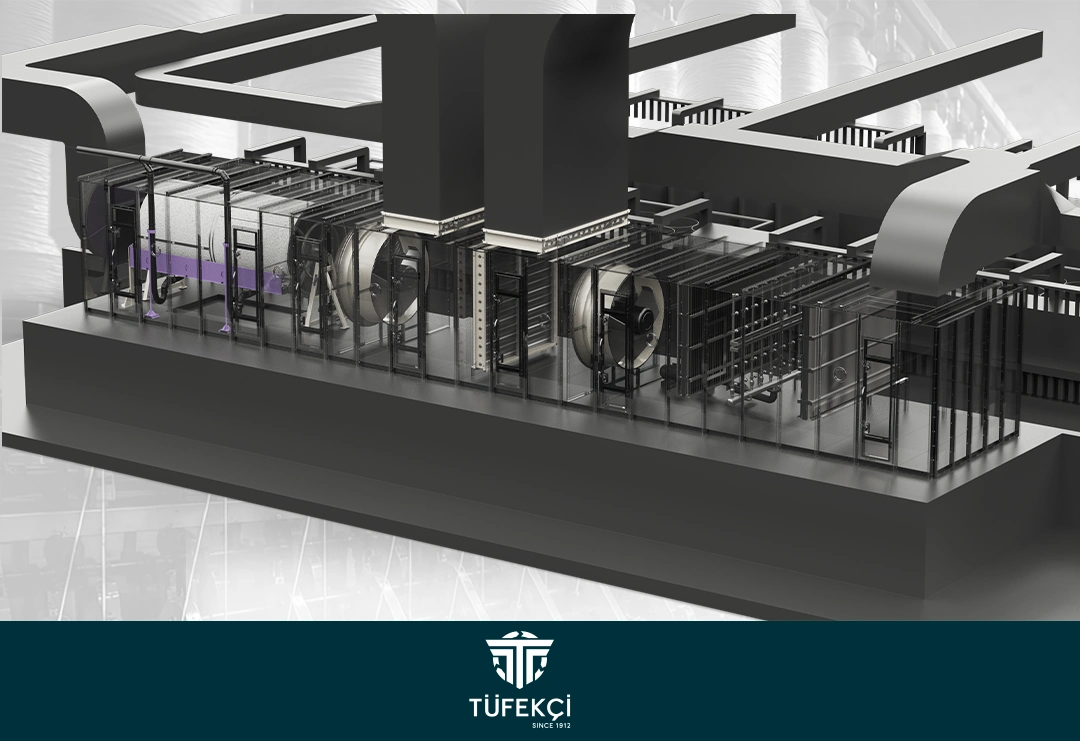
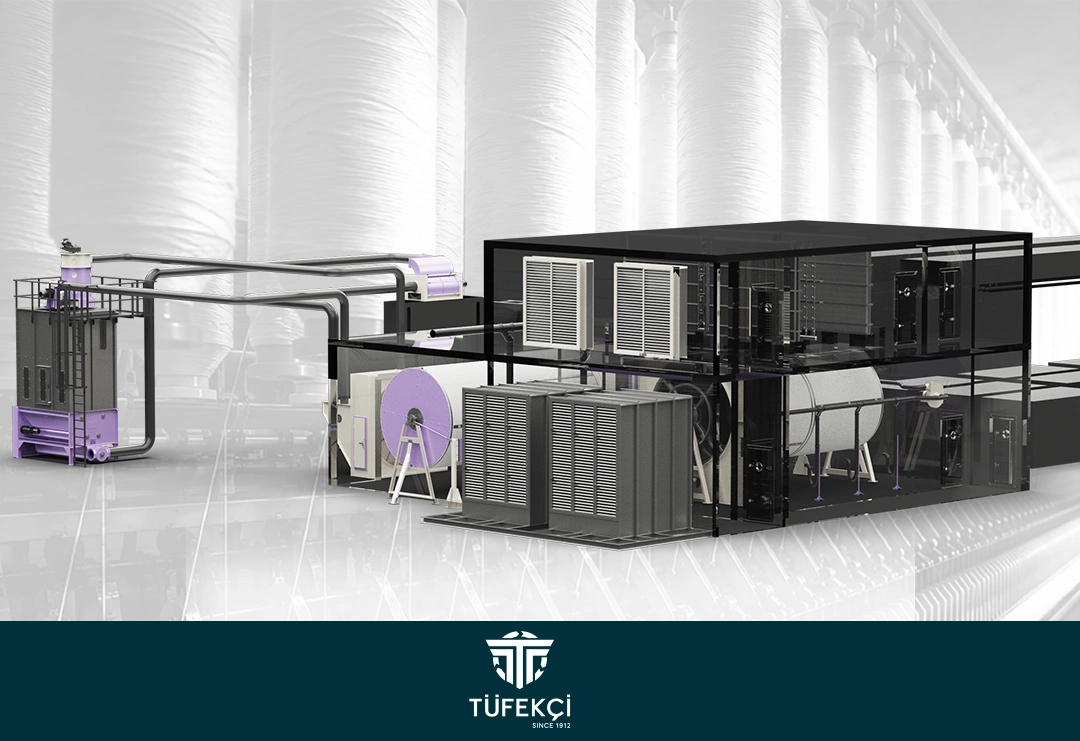
A package-type power plant brings the entire air conditioning and filtration chain of a textile facility into factory-built units that arrive ready to run. Instead of constructing filter chambers, air channels and washer sections on site out of masonry and sheet metal, the plant room is delivered as a set of closed bodies that only need to be positioned, connected and started. For a spinning mill or a weaving hall working against a tight commissioning calendar, that difference is measured in weeks.
Tüfekçi Makine builds this range around two groups. The air conditioning side handles temperature, humidity and air distribution through the packaged air handling unit. The dust and fiber waste collection side takes the return air from production, strips out lint and dust in stages, and sends clean air back into the hall. Both groups share the same logic: complete components inside one durable body, tested before shipment, with maintenance access designed in from the start.
Below you will find how each unit in the package range works, where these systems make the most sense, and how they compare with the classic approach that many mills still use.
What a Package-Type Power Plant Actually Changes on Site
The traditional plant room is built into the building. Concrete chambers, brickwork partitions, on-site insulation and hand-fitted panels all have to be completed before a single fan can turn. Any dimensional mistake made during construction stays with the mill for its whole service life, and later capacity changes usually mean breaking something apart.
Packaged units move that work into the factory. Body panels, fans, coils, filter surfaces and control elements are assembled under workshop conditions, checked for leakage and alignment, then shipped as finished sections. On site the crew positions the units, makes the duct and electrical connections and moves to commissioning. Civil works shrink to a prepared floor and service connections.
There is a second benefit that only shows itself after a few seasons. Because the casing is manufactured rather than built, panel joints stay tight, insulation performance stays predictable and air leakage remains low. A leaking masonry chamber quietly wastes fan energy every hour the mill runs, and the loss rarely appears in any report. A sealed steel body does not have that problem.
Capacity planning also becomes easier. Adding a second unit later is a matter of space and connection points rather than demolition, which suits facilities that expand line by line instead of all at once.
The Packaged Air Handling Unit
Temperature and relative humidity decide how yarn behaves. Too dry and fibers break, static builds and machine stops multiply. Too damp and the material sticks, quality drifts and energy is wasted. The packaged air handling unit is built to hold that balance without drama.
All core sections sit inside one compact body: air intake, filtration, heating and cooling, humidification and the supply fan group. Because the sections are matched to one another during design, airflow across the unit stays even and the hall receives homogeneous distribution rather than hot corners and damp aisles. That consistency is what production planners feel most, since it keeps machine performance stable across the whole floor.
The modular structure lets the same product family serve very different capacities. A small knitting operation and a large ring spinning hall need the same control quality but very different air volumes, and the unit is sized accordingly rather than forced into a fixed catalogue step.
Energy behaviour deserves a mention as well. Fan selection, coil surface and automation work as a set, so the unit does not spend power correcting problems created by its own layout. Over a three shift schedule this shows up directly in the electricity bill. You can see how this fits the wider system design under textile air conditioning solutions.
Packaged Dust and Fiber Waste Collection Units
Return air from a textile hall carries fiber, lint and dust in quantities no general purpose filter would tolerate for long. The packaged filtration group handles that load in stages, each unit taking care of a specific part of the job before passing the air on.
- Packaged Pre-Filter Unit: catches coarse dust and fiber at the first stage. Its real value is protective, since everything downstream lasts longer and works cleaner when the heavy material never reaches it.
- Packaged Rotary Filter Unit: continuous filtration with a self-cleaning working principle, suited to halls where the fiber load never really pauses and manual cleaning is not realistic.
- Packaged Mechanical Filter Unit: separates dust and fiber by physically holding particles on specially designed filter surfaces, a dependable choice for environments with medium dust density and constant fiber presence.
Each of these arrives with its filter modules accessible from service doors, so cleaning and replacement happen without dismantling ductwork. The full group sits under packaged dust and fiber waste collection products, and the wider system picture is covered in dust and lint collection solutions.
Where These Systems Fit Best
Package-type plants are not the answer to every layout, but there are situations where they clearly outperform built-in rooms:
- New facilities working to a fixed opening date, where civil construction time is the main constraint
- Existing mills adding a line and needing conditioning capacity without touching the main structure
- Buildings with limited plant room space, where a compact footprint decides what is possible
- Rented or temporary production sites, since packaged units can be relocated
- Projects in regions where finding skilled on-site fabrication labour is difficult or expensive
- Yarn, weaving, knitting and fiber preparation areas that need precise temperature and humidity control
If your project falls outside these patterns, a construction-type power plant may still be the better economic answer, and that comparison is worth making before equipment is ordered.
Choosing Between Package Type and Construction Type
The decision usually comes down to three questions: how much space you have, how fast you need to start production, and how likely your capacity is to change.
Space favours packaged units. They occupy a defined footprint and do not require the extra volume that masonry chambers and access corridors consume. In older buildings with low ceilings or awkward column spacing, this is often the deciding factor.
Speed also favours packaged units, and by a wide margin. Factory assembly removes most of the sequential waiting that on-site construction imposes, since nothing has to cure, dry or be inspected before the next trade can begin.
Large, very high capacity plants built into purpose-designed buildings can still make a strong case for construction type, particularly when the mill is planning a single fixed configuration for decades. Both approaches are covered in the full product range, and an engineering review of your building will tell you which one is genuinely cheaper across the life of the plant.
Automation and Control Across the Range
A packaged plant is only as good as the logic running it. Sensors reading temperature, humidity and pressure feed the control panel, which adjusts fan speeds, damper positions and humidification output continuously rather than in coarse steps.
That continuous adjustment is where the energy saving lives. A system that reacts to actual hall conditions runs its fans at the speed the moment requires, instead of holding maximum output all shift as insurance. Over months, the difference between reactive and fixed operation is substantial.
Monitoring matters too. When operators can see set points, alarms and trends from a central screen, small deviations get corrected before they turn into quality complaints. Control panel options, SCADA integration and sensor groups are detailed under electrical and automation solutions and our electrical and automation products.
Maintenance, Service and Spare Parts
Packaged construction simplifies maintenance because everything was designed to be reached. Filter modules slide out through service doors, fan sections have proper access, and there is no need to cut into masonry to inspect a component.
A sensible routine covers filter surface checks, pressure drop readings, fan and bearing inspection, and a look at humidification and coil sections before each season changes. Most problems announce themselves through rising pressure drop long before they cause a stoppage, which is exactly why the reading is worth logging.
Original spare parts keep the unit performing as it was designed to. Substitute filter media or mismatched components change airflow characteristics in ways that are hard to trace later. Requests can be made through the spare parts request and service request forms.
Planning Your Project With Tüfekçi Makine
Every mill has its own building, its own machine park and its own air balance. Selecting a packaged plant properly starts with hall volume, machine heat load, target humidity, fiber type and shift pattern, not with a catalogue page.
The engineering team works from those figures to size the air handling and filtration units together, so the two sides of the plant match rather than compete. Layout drawings, connection points and control philosophy are agreed before manufacturing begins.
In short, if you want a textile plant room that arrives finished, starts quickly and stays serviceable for years, the package-type range is built for exactly that. Send your project details through the quotation request form or reach the team directly via the contact page.
