





A textile plant's climate and waste collection system is a chain of motors: supply fans, exhaust fans, dust fans, dampers, filter drives, humidification pumps and conveying lines. Every one of them has to start at the right moment, run at the right speed and stop safely when something goes wrong. That coordination does not come from the mechanical equipment itself. It comes from the electrical infrastructure behind it, and that is exactly what the group of electrical and automation products of Tüfekçi Makine is built for.
The category covers six product families that fit together as one control layer: central motor control panels, automation panels, automation and software panels, panel-controlled systems, SCADA systems and sensor groups. Power distribution and motor protection sit at the bottom, control logic sits in the middle, and monitoring and reporting sit on top. Each product can be supplied on its own for a retrofit, or the whole layer can be engineered as a single package for a new plant.
What makes this group different from generic panel building is the application knowledge behind it. The panels are designed around the actual equipment they will drive, meaning the fans, filters, humidifiers and waste transport lines used in spinning, weaving, knitting, nonwoven and yarn dyeing facilities. Set points, alarm limits, interlocks and sequences are written for textile conditions, not adapted afterwards from a general purpose template.
What the Electrical and Automation Product Range Covers
The starting point is power. Central motor control panels distribute energy to every motor in the system and protect each circuit individually, so a fault in one fan branch does not take the rest of the plant down with it. From there, the control side takes over and decides how those motors behave over the course of a shift.
Above the power layer, automation panels and software panels carry the PLC hardware and the application program. They read what the plant is doing, compare it against the target conditions and adjust fan speeds, damper positions and humidification output accordingly. Panel-controlled systems are the packaged version of this idea, where a specific machine group is delivered ready to run under its own control cabinet.
The top layer is visibility. SCADA systems collect all of this data into a single screen, store it and turn it into reports that a plant manager can actually act on. Sensor groups feed the whole structure with temperature, humidity, pressure and level measurements, which is why they are treated as a product family of their own rather than as accessories.
Together these six families serve all three of the company's main solution areas: textile air conditioning, dust and lint collection and complementary systems. The broader engineering approach behind them is described under electrical and automation solutions.
Central Motor Control Panels (MCC): One Command Point for Every Motor
In a mill that runs dozens of motors, scattered local starters make troubleshooting slow and energy behaviour hard to predict. Central motor control panels solve this by managing all motor loads safely and efficiently from a single centre, with each outgoing feeder protected, switched and monitored in its own compartment.
Balanced starting matters just as much as protection. MCC panels provide soft start and drive integration so that large axial fans and radial fans ramp up instead of slamming onto the line. This balances the energy load and reduces the risk of sudden current surges that stress cables, contactors and bearings.
The practical result is a quieter electrical system and longer equipment life. Motor groups that run in a controlled sequence put less mechanical shock into couplings and impellers, and the plant avoids the demand peaks that inflate energy bills.
Maintenance also gets simpler. Because every motor has a labelled, isolated compartment, a technician can trace a fault, lock out one circuit and work on it while production continues elsewhere in the plant.
Automation Panels and Software Panels: Where the Control Logic Lives
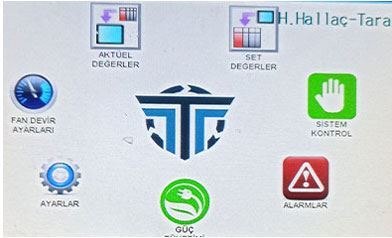
Automation panels hold the PLC, the I/O modules and the operator interface that turn raw signals into decisions. They read the values coming from the field and drive the outputs that keep conditions inside the tolerance the process needs, shift after shift.
Automation and software panels go one step further by combining that hardware with the application program written for the facility. Recipes for different yarn counts, seasonal operating modes, night and weekend schedules and filter cleaning cycles are all defined here rather than left to manual intervention.
This is where energy savings usually come from. Instead of running fans at full speed all day, the program modulates airflow against measured demand and repositions aluminium air dampers to use return and fresh air in the most efficient proportion available at that moment.
Interlocks are the other half of the job. Filter drives, humidification units and waste transport equipment are linked in logical order, so nothing runs dry, blocked or out of sequence.
SCADA Systems: You Cannot Optimise What You Cannot See
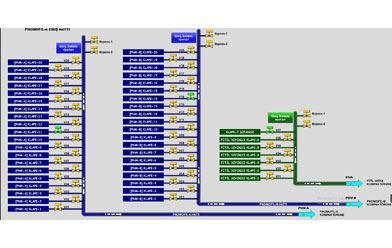
SCADA systems give the plant a live picture of itself. Airflow, temperature, humidity, filter differential pressure, motor status and energy consumption all appear on one screen, updated in real time and archived for later analysis.
Alarm and fault tracking is the feature most teams notice first. When a filter loads up, a fan trips or a sensor drifts outside its range, the system flags it with a time stamp instead of leaving the maintenance team to discover the problem through a quality complaint two days later.
Reporting turns that history into evidence. Energy and performance reports show which zones consume the most, how conditions varied across shifts and whether a change in set points actually paid off. Remote access lets a supervisor or an engineer check the same information from outside the plant.
Over time the archived data becomes the basis for planning. Maintenance intervals, filter change schedules and capacity decisions stop being guesses and start being calculations grounded in what the facility really did.
Sensor Groups: The Measurements Everything Else Depends On
Every automatic decision in the plant starts with a measurement, and a wrong reading produces a wrong action with full confidence. That is why sensor groups are selected for the environment they will sit in, where lint, moisture and vibration are constant.
The measurement points that matter most in a textile installation include:
- Temperature and humidity sensors placed in production halls, return air ducts and mixing chambers to hold the conditions each process needs
- Differential pressure transmitters across pre-filters and rotary filters to show exactly when cleaning or a filter change is due
- Duct pressure and flow sensors that let fan speed follow real demand instead of a fixed setting
- Level and fullness sensors on silos, compactors and waste lines to prevent overflow and blockage
- Motor and drive feedback signals that report current, speed and fault status back to the control layer
Sensors also protect the equipment itself. A blocked duct or a saturated filter is visible in the pressure trend long before it becomes a stopped fan, which is the difference between planned maintenance and an unplanned line stop.
Panel-Controlled Systems: Equipment Delivered Ready to Run
Panel-controlled systems are the answer for facilities that want a machine group to arrive complete rather than be wired together on site. The mechanical unit and its control cabinet are engineered, tested and commissioned as one product.
This approach fits packaged installations especially well. A packaged air handling unit or a filter unit that carries its own panel needs only power and communication on site, which shortens installation time and removes a large share of the field wiring errors that delay start-up.
It also helps with staged investment. A mill can automate one hall or one waste line first, prove the results, then extend the same control philosophy to the rest of the plant without redesigning anything already installed.
Choosing the Right Configuration for Your Facility
Not every plant needs the full stack on day one, and the honest answer usually depends on the size of the motor list and how much visibility the management team wants. A short set of questions narrows it down quickly:
- How many motors are involved? Beyond roughly fifteen to twenty drives, a central MCC becomes easier and cheaper to operate than distributed starters.
- Do conditions vary by product or season? If yes, an automation and software panel with recipe management pays for itself in stability and energy.
- Is energy being measured or estimated? Facilities without measurement almost always find savings once SCADA reporting is running.
- How far is the plant from the maintenance team? Remote access matters more when technical staff cover several sites.
- Is this a new build or a retrofit? Retrofits often start with sensor groups and one MCC, then grow.
Existing panels can usually be integrated rather than replaced, provided the protection level and cable infrastructure are suitable. The full product range is worth reviewing together with the mechanical equipment, since the two are specified as one system.
Commissioning, Service and Continuity
A panel is judged at start-up, not in the workshop. Commissioning covers loop checks, direction tests, alarm verification and the tuning of set points against real production conditions, with operator training given on the same screens the team will use daily.
Documentation stays with the plant. Wiring diagrams, I/O lists, parameter sets and program backups mean a future modification or a component swap does not require reverse engineering.
Support continues after handover through the service request and spare parts request channels, so a faulty sensor or drive can be replaced with a matching component instead of an approximation.
In short, the electrical and automation product range is what turns individual machines into a plant that behaves predictably. For project pricing you can use the quotation request form, or reach the engineering team directly through the contact page.
